Amritsar, India
Scroll down for Photos below:
Summary: We had a long day full of memorable experiences. We left Himachal Pradesh behind as we entered Punjab on our way to Amritsar. Our guide, Ajay was able to conjure up VIP seats to allow to see the testosterone-laced, over the top and, oh so theatrical, flag lowering ceremony at the India-Pakistan border. After an amazing veg dinner at Bade Bhiai ka Brother’s Dhaba, we headed to the Golden Temple take in the sights and sounds of Sikh services while bathing in the ambience of 1600 kg’s of gold that was used to create the temple as it glowed in the light.
Drive and Border Fun: As we left Dharmasala on our way to Amritsar, the tea plantations of the green foothills of Himachal Pradesh gave way as the plains of Punjab, the breadbasket of India, opened before us. Partition of the area (into India and Pakistan) by the British in the 1940’s resulted in a massive bidirectional Islamic-Hindu migration that uprooted numerous people (and caused racial/religious fighting result in innumerable deaths.) This lead to assive emigration to Britain and Canada. Interestingly, the area is now considered very well off due to the NRA money (bank accounts belonging to non-residents) that flows in from overseas relatives.
We stopped along the way to visit the ruins of a Muslim hill fort that overlooked the Kanga Valley.
After the mountain roads of Himachal Pradesh, I was quite relieved to arrive at a section of 4 lane divided highway. Unfortunately, my excitement was a little premature. They were still doing extensive work on the roadway so there were numerous, poorly marked detours. As a result, there was bidirectional traffic on both sides of the freeway. The fact that this defeated the purpose of a divided roadway was demonstrated by the two rather bad accidents that we say along the way.
We arrived in Amritsar early to assure that we would have plenty of time to make it to see the Flag lowering ceremony at the Attari-Waga (India-Pakistan) border. Ajay, our guide, scored us seats in the VIP section. We drove passed hundreds of people who were waiting in line to arrivea at a parking lot right beside the entrance to the “theater” (bleachers situated along both sides of the border). During the hour or so that we waited, the non-VIP section seemed to have a lot more fun somehow though. The crowd was filled with national pride: cheering, jeering and even a spontaneous Bollywood dance party that erupted with great energy. The ceremony itself was pure, puffed up pomp. I took it as a very tongue in cheek ceremony that allowed a little friendly competition between crowds on the opposing Indian and Pakistani sides to show pride in their respective countries. While the tight uniforms, high kicks and macho posturing was quite entertaining, I think that the most memorable part of the event was actually leaving the area after it was all over. We were shuffled through a small gate at the side of the border as were people on the Pakistan side. The exit sidewalks on both sides of the border are mere feet away from each other. It was quite a reassuring and heartwarming experience to watch people on both sides smiling, waving and taking pictures of each other.
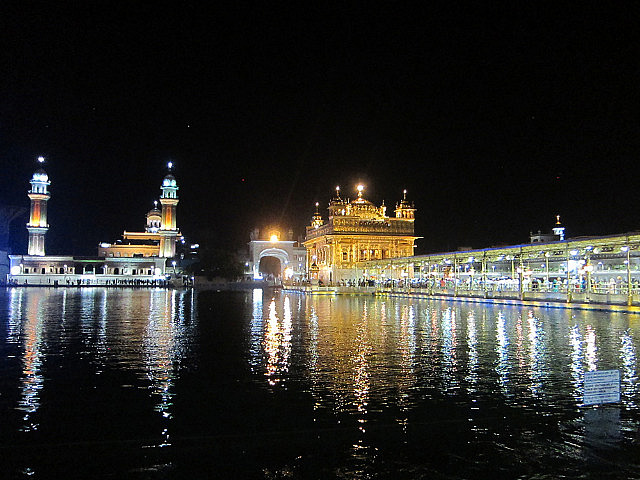
Dinner and Temple: We enjoyed Thali for dinner, an array of scrumptious all veg dishes that we soaked up with perfectly cooked coiled rolled flat bread. After a quick ride on a rickshaw bicycle, we were dropped off at the Golden Temple, the spiritual centre of the Sikh religion.
The temple is situated in the middle of a massive field of white marble. We were told by our guide that the 2 story structure was created with 1600 kg of gold leaf. The pool of sacred nectar that surrounds the temple reflects the gleaming radiance of the well lit structure. At the end of the evening we even saw the holy Sikh scriptures being carried from the temple to its overnight resting place.
The Golden Temple is known for providing free food to all those who want it, serving thousands of portions a day. We were able to see the food prep areas, the (bread) bakery and the highly organized lively and very noisy dish washing section.
Overall it was a fantastic experience. I only wish that we had more time to spend there. The people were so friendly. I guess that white vacationers are a bit on the exotic side. People were smiling, chatting and posing for pictures with us. Even though I didn’t understand the religious aspects of what was happening, I was blown away by the beauty of the surroundings and by watching Sikhs have a completely different experience. It was somehow comforting (and maybe a little voyeuristic) seeing people experiencing what was an obvious and literal religious experience for them. I would have loved to have parked myself on a slab of marble, people watched and absorbed the atmosphere to try to feel more connected.
Visit to Jallianwala Bagh: Scott and I set out the next morning to find an ATM and possibly head to see the sight of a pivotal episode on India’s road to independence from the British. Jallianwalla Bagh is a fenced-in park where, in 1919, a prayer meeting was held as part of a religious celebration. Having recently banned all public gatherings, the British army opened fire on the crowds without warning, killing over a thousand people. 120 people jumped to their deaths into a well to avoid being shot. The effects of this incident polarized the population and fed the flames of independence movement.
Toto Description: After breakfast, we drive to Amritsar, in the state of Punjab, in the Himalayan foothills called the Shivaliks. Being the gateway for travelers coming to India on the overland route from Central Asia, it soon became the center of various commercial activities. Amritsar, home of the Golden Temple, is one of the most ancient and fascinating cities in India. It is an important seat of Sikh history and culture. Driving throughout the morning, we arrive in Amritsar for lunch. In the afternoon, we visit the Golden Temple, famous for its full golden dome, one of the most sacred pilgrimage sites for Sikhs. The Mandir is built on a 67-foot square of marble and is a two-storied structure. Maharaja Ranjit Singh had the upper half of the building built with approximately 400 kg of gold leaf. Several other temples, such as the Durgiana Temple, surround the Golden Temple. The temple complex is like a small community, filled with many different activities. We visit the kitchen where free meals are prepared by volunteers throughout the day, and the temple where the holy book, Aad Guru Sahib, is read aloud from 4 am to 10 pm daily. We have the opportunity to observe devotional rituals. Upon check-in to our hotel in the late afternoon, the remainder of the day is free.


 2GuysTravel